10 No-Prep Phonics Games for the Kitchen Table
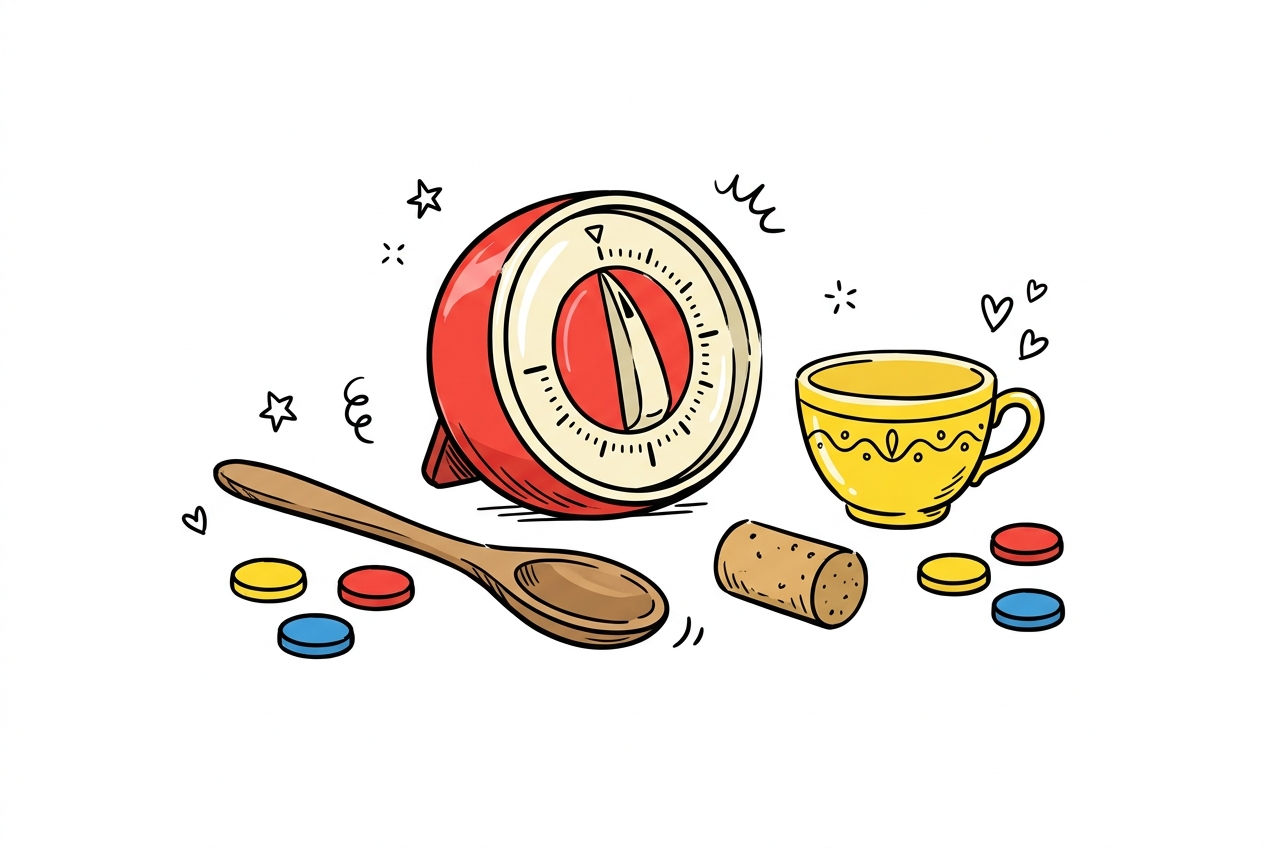
You can build real phonics skills at the kitchen table with no printing, no apps, and no special equipment. These ten games take five minutes or less — each one targets a specific skill (blending, segmenting, letter sounds, or rhyming) so you can choose by what your child is working on, not by chance.
Ten games might sound like a lot to keep track of, but you’ll probably find your child has a favourite within the first two rounds. Start there. The games are organised by the skill they build, so if a teacher mentions that blending is the current focus, you can go straight to games 1 and 2 tonight.
Why do short home games make a real difference?
The reason is repetition, and repetition does not have to happen at a desk. A 2024 study in Behavioral Sciences tracked 50 preschoolers over six months and found that as parents increased their home literacy activities, children’s letter knowledge, phonological awareness, and writing skills all grew alongside, with motivation rising at the same rate (Deitcher, Aram, & Abramovich, 2024).
The games below focus on the two skills with the largest evidence base for early reading gains. A 2024 meta-analysis in Scientific Studies of Reading — examining 35 effect sizes across 16 studies — found that blending and segmenting each produced effect sizes near 0.8, well above the effect sizes seen for other phonological tasks (Erbeli et al., 2024). Both skills are easy to practise with nothing but your voice.
10 games organised by skill
| Game | Skill it builds | What you need | Time |
|---|---|---|---|
| 1. Sound Robot | Blending | Your voice | 3 min |
| 2. Stretchy Snake | Blending | Your voice | 3 min |
| 3. Finger Tapping | Segmenting | Your hands | 3 min |
| 4. Sound Cups | Segmenting | 3 cups + small objects | 5 min |
| 5. I Spy with Sounds | Letter-sound links | Your voice | 4 min |
| 6. Sound Hunt | Letter-sound links | Kitchen objects | 5 min |
| 7. Rhyme Chain | Rhyming | Your voice | 3 min |
| 8. Odd One Out | Rhyming | Your voice | 3 min |
| 9. Change the Start | Phoneme substitution | Your voice | 4 min |
| 10. Beat the Clock | Blending fluency | A kitchen timer | 5 min |
How do I help my child hear separate sounds blend into a word?
Blending (taking /k/-/a/-/t/ and arriving at cat) is one of the skills the National Reading Panel (2000) identified as essential for early reading. These two games train exactly this, with no equipment required.
Game 1: Sound Robot. Speak a word in a flat, mechanical voice: “/k/… /a/… /t/.” Your child shouts back the real word. Start with two-sound words (at, on, up) and move to three-sound CVC words once the pattern clicks. The robot voice is the whole prop. The payoff moment: the instant your child hears “/d/-/o/-/g/” and shouts dog without hesitating — that is blending happening in real time.
Game 2: Stretchy Snake. You are a snake. Stretch a word out: “mmmmaaaannn.” Your child squeezes it back to its normal size: man. The exaggerated slow version gives the brain a target to aim at before it has to work quickly. Switch roles — your child stretches, you guess — and the game becomes a segmenting warm-up at the same time.
For a deeper look at the blending skill itself, see how to teach your child to blend sounds at home.
How do I help my child break a word into its individual sounds?
Segmenting is the spelling half of the phonics pair: hearing dog and knowing it holds three sounds (/d/-/o/-/g/). It is also what gives a child their first real foothold on spelling independently.
Game 3: Finger Tapping. Say a word and ask your child to tap one finger for each sound they hear. Cup: three taps. In: two taps. Ship: three taps (because sh is one sound, not two). The physical tap grounds an abstract idea in something concrete and gives you an instant view of what they are actually hearing.
Game 4: Sound Cups. Line up three cups on the table. Say a word aloud. Your child drops a small object — a button, a coin, a dried pasta piece — into one cup per sound, moving left to right. Fan gets three drops; she gets two. Count together afterward. The left-to-right direction quietly reinforces how print is read at the same time.
How do I help my child connect letters to their sounds?
Building a reliable link between a printed letter and the sound it represents is the engine of decoding. The two games below reinforce phonemic awareness while turning everything on the kitchen table into a teaching prop.
Game 5: I Spy with Sounds. The original game, reprogrammed. Instead of “I spy something beginning with the letter B,” say “I spy something beginning with the sound /b/.” That small switch trains phoneme perception, not just alphabet knowledge. The letter name bee tells a child almost nothing about reading; the sound /b/ is the bridge to decoding a new word.
Game 6: Sound Hunt. Call out a sound (“/s/”) and your child hunts the kitchen for objects that start with it. Salt. Spoon. Sieve. Set a 60-second limit and count the finds. The best rounds end with your child deciding your sound was too easy and inventing a harder one to stump you.
How do I help my child hear rhymes?
Rhyming is an early sign that a child is beginning to hear language as a pattern of sounds, not just as meaning. It is one of the first phonological awareness skills to develop, typically appearing around ages 3–4.
Game 7: Rhyme Chain. Take turns adding a rhyming word. cat, hat, sat, bat… Whoever cannot add one loses the round. The chain can start with any word; starting with something absurd (“snort!”) tends to produce more enthusiasm than starting with cat again.
Game 8: Odd One Out. Say three words: two that rhyme and one that doesn’t. Cup, dog, pup. Your child identifies the odd one. Once they are confident with that direction, let them set the trap. Children who design the puzzle tend to concentrate harder than children solving it.
How do I help my child swap sounds inside words?
The ability to change, add, or remove sounds in words (called phoneme manipulation) is among the stronger predictors of later reading progress. It also happens to be the most playful of all phonics skills.
Game 9: Change the Start. Say a word. Ask your child to change the first sound. Cat → swap /k/ for /b/ → bat. Then /b/ for /m/ → mat. Cycle through the alphabet together and see which swaps land on real words. The rounds that accidentally produce a non-word (“zat!”) are usually the most memorable.
Game 10: Beat the Clock. Set a kitchen timer for 30 seconds. Call out a sound (“/p/”). Your child names as many words as possible that start with that sound before the timer beeps. Count together, then try to beat the score with a new sound. The time pressure shifts the game from careful thinking to confident, automatic retrieval — which is exactly the fluency you are building toward.
FAQ
How long should a phonics game session last at home?
Three to five minutes is enough for ages 4–6. Short, frequent sessions (even two or three minutes during a snack) build more durable skills than occasional long ones. Stop while your child still wants more and the next session will start itself.
My child is 4. Are these games too early?
Four is a good age for the rhyming games and Sound Robot with two-sound words like at and on. Phonological awareness develops steadily from about age 3, and playful exposure before formal phonics instruction consistently helps children when lessons begin.
Which game should we start with tonight?
Sound Robot. It takes 90 seconds, the robot voice usually gets a laugh, and within one round you’ll know whether two-sound or three-sound words are the right level. That tells you where to go next.
What if my child gets frustrated and refuses to play?
Step back one level. If three-sound words feel impossible, two-sound words almost always feel achievable — and a small win resets the mood quickly. Letting your child be the one who sets the puzzle usually improves participation too.
Do these games replace a reading programme or school phonics lessons?
No, and they don’t need to. They build the sound-level foundations that make formal phonics instruction land better, and they complement whatever your child is doing at school because the same skills apply in both places.
Can we play these games in a language other than English?
Yes. Blending, segmenting, and rhyming games translate directly into any language. The specific sounds and word patterns differ, but the mechanic — stretch it, tap it, change the first sound — works the same way.
If you’d like your child to get that same warm “you got it” moment with immediate feedback and games that adjust to where they are, Snappy was built for exactly that five-minute window at the kitchen table.
Frequently asked questions
How long should a phonics game session last at home?
Three to five minutes is enough for ages 4–6. Short, frequent sessions (even two or three minutes during a snack) build more durable skills than occasional long ones. Stop while your child still wants more and the next session will start itself.
My child is 4 — are these games too early?
Four is a good age for the rhyming games and Sound Robot with two-sound words like 'at' and 'on'. Phonological awareness develops steadily from about age 3, and playful exposure before formal phonics instruction consistently helps children when lessons begin.
Which game should we start with tonight?
Sound Robot. It takes 90 seconds, the robot voice usually gets a laugh, and within one round you'll know whether two-sound or three-sound words are the right level. That tells you where to go next.
What if my child gets frustrated and refuses to play?
Step back one level. If three-sound words feel impossible, two-sound words almost always feel achievable — and a small win resets the mood quickly. Letting your child be the one who sets the puzzle usually improves participation too.
Do these games replace a reading programme or school phonics lessons?
No, and they don't need to. They build the sound-level foundations that make formal phonics instruction land better, and they complement whatever your child is doing at school because the same skills apply in both places.
Can we play these games in a language other than English?
Yes. Blending, segmenting, and rhyming games translate directly into any language. The specific sounds and word patterns differ, but the mechanic — stretch it, tap it, change the first sound — works the same way.
Reviewed against: National Reading Panel (2000) — phonemic awareness and systematic phonics instruction; Erbeli, Rice, Xu, Bishop & Goodrich (2024) — optimal PA dosage meta-analysis, Scientific Studies of Reading; Deitcher, Aram & Abramovich (2024) — home literacy activities and early literacy skills, Behavioral Sciences; Reading Rockets (Library of Congress / U.S. Department of Education).