How to Teach Your Child to Blend Sounds at Home
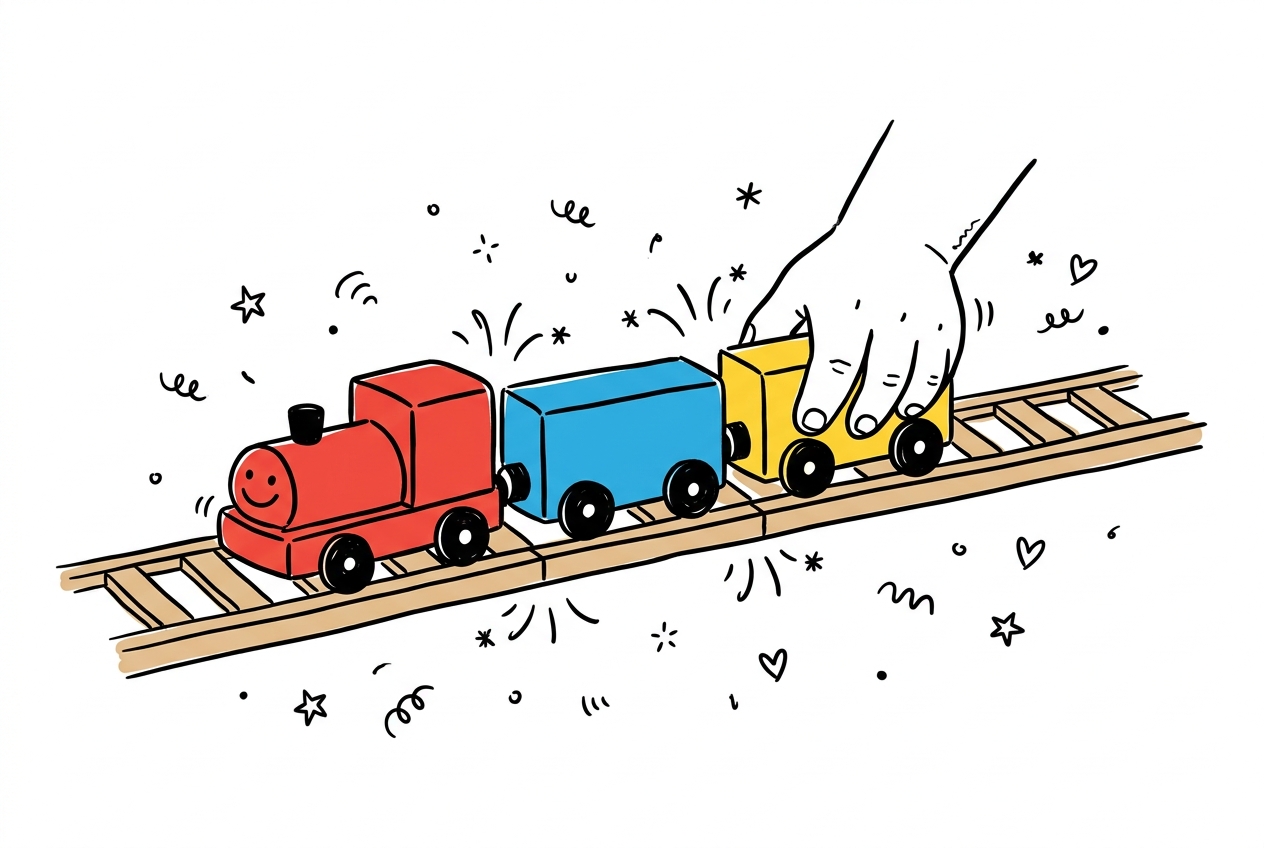
Blending means pushing separate sounds together to form a word: /k/ + /a/ + /t/ = cat. Start with two-sound words, say each sound slowly, then slide them together. A few minutes of playful daily practice — with toys, words from books, or simple games — is enough to get the habit going.
Your 5-year-old has been learning letter sounds for months. They can say /k/, /a/, /t/ without trouble. But when you point to cat on the page, nothing happens. The sounds stay separate, three islands that never quite connect.
This is one of the most common sticking points in early reading — and it has a name: blending. It is also one of the most teachable skills, often requiring nothing more than five minutes a day and a few small objects from home.
What exactly is blending, and why does it matter?
Blending is the act of holding a sequence of sounds in working memory and merging them into a single recognisable word. It is one half of a two-way skill: segmenting breaks a word apart into its component sounds (/k/ /a/ /t/), and blending puts those sounds back together (cat). Both matter, but blending is the one a child uses at the moment of reading an unfamiliar word off the page.
The National Reading Panel (2000), whose meta-analysis of hundreds of early literacy studies has shaped reading instruction in many countries, identified phonemic awareness — including blending — as one of the five essential pillars of effective reading instruction. Children who receive explicit, structured blending practice decode new words more reliably than those who encounter letters without this sound-level foundation.
Why do so many children find blending hard at first?
The difficulty is rarely the individual sounds. Most children who have had some phonics exposure can say /m/, /a/, and /t/ in sequence without trouble. The challenge is merging those sounds without inserting a small puff of air between each one.
When a child says “/m/-/a/-/t/” as three separate beats, they often arrive at something like “muh-ah-tuh” rather than mat. Not because they are confused, but because consonants like /m/ naturally carry a brief aspiration when said in isolation.
Reading Rockets, a national literacy initiative supported by the Library of Congress and the U.S. Department of Education, describes this gap between knowing individual sounds and producing blended words as one of the most common early phonics hurdles. The fix is practical: model a smooth, continuous slide from one sound into the next, the way you might stretch mmmaaat in slow motion before saying it normally.
A simple step-by-step blending routine for home
You do not need printed worksheets or specialist resources. A kitchen table works well.
Step 1 — Start with two-sound (VC) words. Before attempting three sounds, practise with vowel-consonant pairs: at, am, up, in, on. Two sounds are easier to hold in memory than three. Ask your child to say each sound, then slide them together.
Step 2 — Move to CVC words. Consonant-vowel-consonant words like cat, pin, hop, bug are the building blocks of early phonics. Say each sound at a slow, steady pace — “/k/ … /a/ … /t/” — then blend smoothly into the whole word. Small objects from a toybox help: push a different toy forward for each sound, then bring all three together.
Step 3 — Use a physical push cue. Elkonin boxes, also known as sound boxes, are a technique developed by Russian psychologist and literacy researcher D.B. Elkonin and widely adopted in reading programmes worldwide. Draw three connected squares on paper; say a sound as you tap each square, then run your finger smoothly across all three while saying the complete word. The left-to-right movement also reinforces the direction of reading.
Step 4 — Blend into words from real books. Once your child can blend cat from isolated sounds, find that word in a familiar story or a simple decodable book and blend it there. Seeing the printed word, mapping the sounds, and reading it in context closes the loop between practice and real reading.
Step 5 — Keep sessions short and end on a win. Five minutes is more than enough. According to Reading Rockets, research consistently shows that brief, frequent sessions build more durable skills than occasional long ones. Always finish with a word you know your child can blend, so the session ends on a confident note.
Which words should you use, and when?
| Stage | Word pattern | Example words | What makes it right for this stage |
|---|---|---|---|
| Starter | VC | at, in, up, on | Only 2 sounds to hold in memory |
| Foundation | CVC | cat, pin, hop, bug | The core early-phonics word type |
| Building | CCVC | stop, plan, drip | Adds a consonant cluster at the start |
| Growing | CVCC | fast, jump, belt | Consonant cluster at the end |
| Stretch | CCVCC | blend, crisp, stamp | For children already reading simple books |
Move up when the current level feels easy and automatic, not when it merely feels possible.
How does blending fit into the bigger picture of learning to read?
Blending sits inside the word-recognition strand of what researcher Hollis Scarborough mapped as the Reading Rope, a widely taught model that shows how multiple skills — phonological awareness, decoding, background knowledge, vocabulary — braid together into fluent reading over time. Without blending, even a child with a rich vocabulary and strong comprehension cannot get words off the page independently.
A child who blends well can decode any regular word they encounter for the first time, even a word they have never seen in print. That is a different and more portable skill than memorising a fixed list of words, and the two approaches complement each other as reading develops.
What if my child knows the sounds but still won’t blend?
This is the question reading teachers hear from parents more than almost any other. The usual answer is that the child can segment a word into sounds but hasn’t yet learned to hear the resulting string as a single unit. They need more practice with the sliding step, not more practice with the individual sounds.
A few things that help:
- Model the smooth version first. Say “listen to my mouth” and stretch /mmmaaat/ continuously before breaking it into separate sounds. The merged version gives the brain a target to aim at.
- Try body movement. Some children blend more reliably when they use their hands: pull them apart for each sound, then clap them together for the full word.
- Reduce the number of sounds temporarily. If CVC words are too much, go back to two-sound VC words until those feel automatic, then reintroduce the third sound.
The National Reading Panel’s findings on phonemic awareness instruction show that systematic, consistent practice — even in short sessions — produces the strongest outcomes. Consistent and gradual is the pattern to aim for.
FAQ
At what age should a child start blending sounds?
Most children are ready to start blending around ages 4½ to 5, once they can reliably hear and say individual sounds. Before that, rhyming games and syllable-clapping are the most productive building blocks. Readiness matters more than calendar age.
Why can my child say the sounds but not blend them into words?
Knowing the sounds and blending them are two separate skills. Blending requires holding sounds in memory and merging them without a gap, which takes practice even when the individual sounds are solid. Repeated slow-slide modelling usually helps within a few weeks.
What are the easiest words to use for blending practice?
Two-sound words like at, in, up are the best starting point because they have the fewest sounds to hold. After those feel automatic, short CVC words like cat, hop, pin are the next step. Avoid words with silent letters or unusual spellings until blending feels natural.
How long does blending practice take to become a habit?
Research on phonics skill development consistently shows that a few weeks of short, daily practice produces a visible shift. The important thing is consistency: five minutes every day outperforms thirty minutes once a week.
What is the difference between blending and segmenting?
Blending means pushing sounds together to form a word. Segmenting means splitting a word into its individual sounds. Segmenting is used in spelling; blending is used in reading. Children usually practise both in parallel, and the skills strengthen each other.
Can blending practice happen outside of formal reading time?
Yes, and it often works better that way. Car journeys, bath time, and the walk to school are all fine venues. Say a word in slow sounds and ask your child to shout the real word — it turns into a game they can beat a grown-up at.
If you’d like your child to hear themselves get a blend right — with instant, warm feedback in the moment — Snappy was built for exactly that. Five minutes, the same playful games above, with a patient ear and a voice that always sounds pleased when they get it.
Frequently asked questions
At what age should a child start blending sounds?
Most children are ready to start blending around ages 4½ to 5, once they can reliably hear and say individual sounds. Before that, rhyming games and syllable-clapping are the most productive building blocks. Readiness matters more than calendar age.
Why can my child say the sounds but not blend them into words?
Knowing the sounds and blending them are two separate skills. Blending requires holding sounds in memory and merging them without a gap, which takes practice even when the individual sounds are solid. Repeated slow-slide modelling usually helps within a few weeks.
What are the easiest words to use for blending practice?
Two-sound words like at, in, up are the best starting point because they have the fewest sounds to hold. After those feel automatic, short CVC words like cat, hop, pin are the next step. Avoid words with silent letters or unusual spellings until blending feels natural.
How long does blending practice take to become a habit?
Research on phonics skill development consistently shows that a few weeks of short, daily practice produces a visible shift. The important thing is consistency: five minutes every day outperforms thirty minutes once a week.
What is the difference between blending and segmenting?
Blending means pushing sounds together to form a word. Segmenting means splitting a word into its individual sounds. Segmenting is used in spelling; blending is used in reading. Children usually practise both in parallel, and the skills strengthen each other.
Can blending practice happen outside of formal reading time?
Yes, and it often works better that way. Car journeys, bath time, and the walk to school are all fine venues. Say a word in slow sounds and ask your child to shout the real word — it turns into a game they can beat a grown-up at.
Reviewed against: National Reading Panel (2000) — phonemic awareness and blending instruction; Reading Rockets (Library of Congress / U.S. Department of Education); Scarborough's Reading Rope — word recognition strand; Elkonin, D.B. — phoneme segmentation and sound boxes technique.