The Magic E Rule: How to Teach Long Vowels at Home
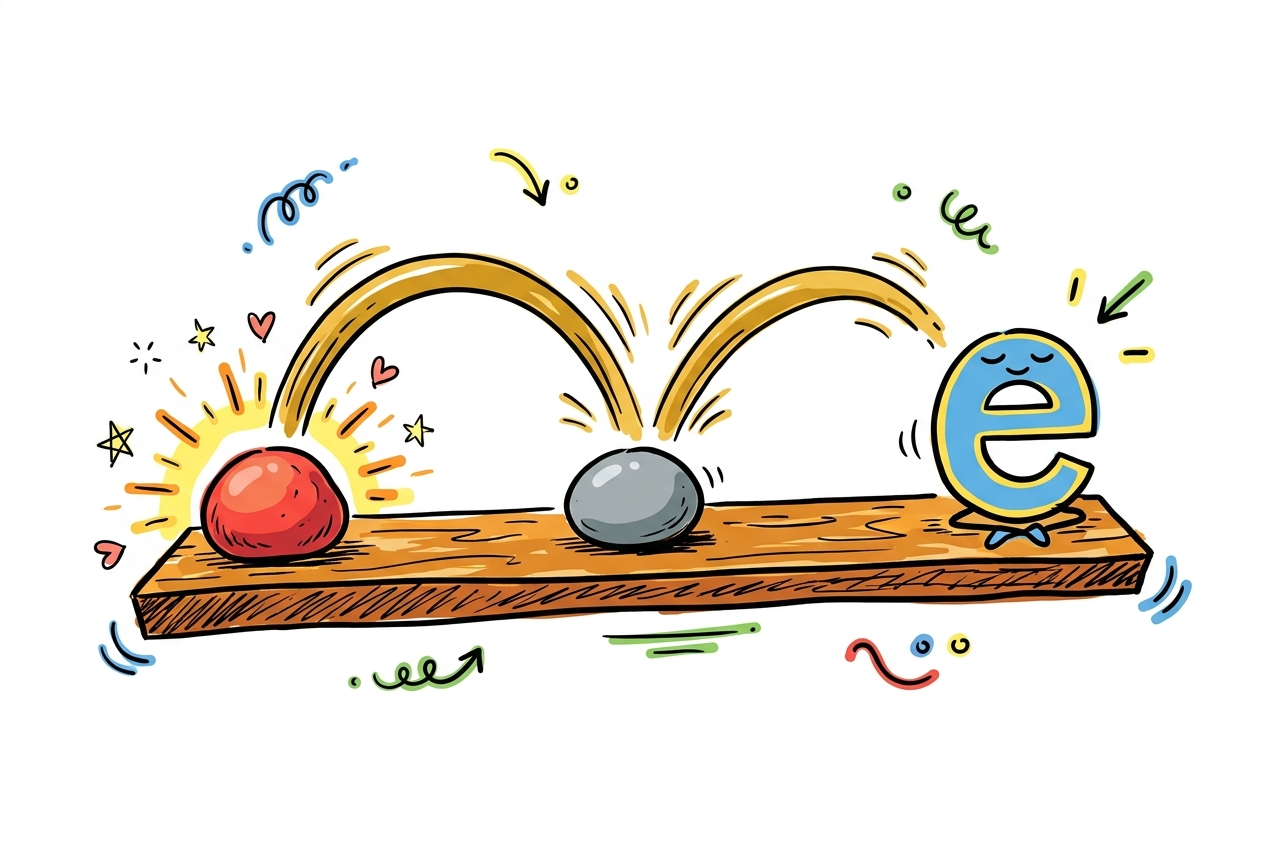
The magic e rule means that when a word ends in a vowel, a consonant, and a silent e, the first vowel says its long sound (its letter name) and the e stays silent. So 'cap' becomes 'cape', 'pin' becomes 'pine', 'hop' becomes 'hope', and 'cub' becomes 'cube'. It's one of the most common vowel patterns in English, typically introduced in first grade after children can read short-vowel words.
Your child has been cracking short-vowel words with quiet confidence: cat, pin, hop, cub. Then they meet cake and try to sound out every letter: “k… a… k… e”. The result is a non-word, and a puzzled look.
This is the exact moment the magic e rule becomes one of the most satisfying things to teach. Once a child sees the pattern, those same four words open up an entirely new set of reading material.
What is the magic e rule?
The magic e rule, also called the VCe pattern or the split digraph, describes something very common in English spelling: when a word ends in a vowel, one consonant, and a silent e, the first vowel says its long sound, the sound that matches its letter name.
Short vowel: pin. Add a silent e: pine. Short vowel: cap. Add a silent e: cape. Short vowel: hop. Add a silent e: hope. Short vowel: cub. Add a silent e: cube.
The pattern is not arbitrary. It is one of the most reliable spelling rules in English: roughly 80 to 85 percent of VCe words follow it consistently, which makes it worth teaching explicitly.
Why does the e make the vowel long?
This is the question children inevitably ask, and “it’s magic” is a charming answer that does not actually help anyone remember. A more useful framing is that the e is a signal letter, or in technical terms a “marker grapheme.”
In a word like pine, the e at the end has no sound of its own. What it does is signal to the reader that the i in the middle is long, not short. The e acts as a code, and once a child cracks that code, they hold the pattern in memory rather than memorising each word separately.
In a 2022 study published in The Reading Teacher, Ehri explained that children learn to read words by mapping graphemes (written units, including multi-letter signals like the silent e) onto phonemes (spoken sounds). Teaching a child to see i_e as a two-part vowel signal, with the e playing a visual role rather than an acoustic one, is exactly the kind of explicit grapheme-phoneme instruction that supports this process. The more clearly a pattern is named and practised, the more efficiently it gets stored in long-term memory.
Which words follow the magic e pattern?
There are five main VCe families, one for each vowel. The table below shows the short-vowel starter word, the long-vowel VCe version, and the most common stumbling block for each:
| Vowel | Short vowel | Add a magic e | Long sound | Common slip |
|---|---|---|---|---|
| a | cap | cape | /eɪ/ as in “day” | Reading cape as /k-a-p-uh/ |
| i | pin | pine | /aɪ/ as in “sky” | Reading pine as /p-i-n-e/ |
| o | hop | hope | /oʊ/ as in “go” | Mixing it up with a short /ɒ/ |
| u | cub | cube | /juː/ as in “few” | Saying cub-uh |
| e | them | theme | /iː/ as in “see” | Very rare pattern; few early words |
The e-e pattern is genuinely rare and can wait. A child who is solid on a-e, i-e, o-e, and u-e will read almost all the VCe words they meet in early reading material.
When is a child ready to learn this?
The prerequisite is short-vowel CVC mastery. If a child can read cat, sit, hot, bug, and wet without stopping to think about each sound, they have the foundation the magic e rule builds on. They also need to be comfortable with blending separate sounds into words, because VCe words add one layer of complexity to a skill that already needs to feel automatic.
In most structured phonics programmes, VCe is introduced in first grade, typically after blends and digraphs but before vowel teams. A child who is still shaky on individual short-vowel words will find the pattern confusing; a child who is bored with CVC words will find it genuinely exciting.
The IES What Works Clearinghouse practice guide on foundational reading skills (2016) recommends teaching the major grapheme-phoneme correspondences in a planned sequence, from simple to complex. CVC words represent the “simple” end of that sequence; VCe patterns are the next significant step.
How do I teach it at home?
Three activities work well without any special materials:
1. The e-slides-in game (minimal pairs)
Write a short-vowel word on a piece of paper: cap. Let your child read it. Then slowly slide a lowercase e card in from the right side until it sits at the end. Say: “Watch what happens when the e arrives.” Let them read the new word.
This makes the vowel shift visible and concrete. Children consistently find it engaging, possibly because turning one word into a different one by adding a single letter feels like a genuinely surprising trick.
After a few minutes, reverse it: start with the long-vowel version and slide the e away. Pine becomes pin. Cape becomes cap. Both directions matter.
2. CVC-CVCe word sort
Write eight to ten word pairs on separate cards: hat / hate, kit / kite, not / note, tub / tube. Mix them up and ask your child to sort them into two groups: “short vowel” and “long vowel with silent e.” Once sorted, read each pair aloud and notice the vowel change.
Word sorts are one of the most-researched spelling-pattern activities because they require children to attend to the relevant feature (the presence or absence of the final e) rather than just reading words in a list.
3. Build, read, write
Build a CVC word from letter tiles or written letters. Read it together. Add an e tile. Read the new word. Then put the tiles away and ask your child to write the long-vowel version from memory. Writing a word immediately after reading it strengthens the grapheme-phoneme mapping that makes words easier to recall next time.
A 2025 study published in Reading Research Quarterly (Lane et al.) followed more than 2,700 kindergarten and first-grade students who received structured phonics instruction with 30 minutes of daily practice. Those students outperformed matched controls by more than one standard deviation in early literacy skills, with first graders gaining the equivalent of almost a year and a half of additional instruction. The key was not the quantity of time but the quality: explicit, systematic teaching of each pattern as its own unit.
What trips children up?
Sounding the e aloud. Many children, especially those who have had good phonics training, feel the urge to give every letter a sound. If your child reads cake as “kak-uh,” a quick finger tap on the e and the word “silent” is usually enough. No explanation needed, just the reminder.
The e-e exception. Words like these and theme use an e-e pattern, which looks strange and has very few decodable examples. There is no need to dwell on this early. One mention is enough: “Sometimes the pattern uses two e’s, like in theme, but that is rare.”
Words where VCe does not apply. Words like come, some, have, and give look like VCe words but do not follow the long-vowel pattern. These are genuinely irregular and are best stored by sight after repeated exposure. The important message for a child is that the pattern is very common but not universal, and irregular words form their own small group learned separately.
If your child is building on solid short-vowel knowledge, the article on CVC words and why they come first gives useful context for why the sequence matters.
FAQ
What is the magic e rule in phonics?
The magic e rule describes the vowel-consonant-e (VCe) pattern: when a word ends in a single vowel, a single consonant, and the letter e, the first vowel says its long sound (its name) and the final e is silent. Examples include cake, bike, home, and cube.
When do children typically learn the magic e rule?
Most children are introduced to the VCe pattern in first grade, after they can confidently read short-vowel CVC words like cat, sit, and hop. Secure blending and short-vowel knowledge are the main prerequisites.
Why is the e silent in magic e words?
The final e is not pronounced; it acts as a visual signal. Its job is to tell the reader that the vowel earlier in the word says its long sound. Linguists call it a “marker grapheme”: present but soundless, doing its work visually rather than acoustically.
How is the magic e rule different from a vowel team?
A vowel team puts two vowels side by side, like the ea in beach or ai in rain. The VCe pattern separates the two vowel signals with a consonant in between (vowel, consonant, silent e). Both patterns produce long vowel sounds but look different on the page.
What are some easy magic e words to start with?
Good starting words for each vowel: a-e (cake, name, lake, same); i-e (bike, time, five, mine); o-e (home, note, rope, bone); u-e (cute, tube, rule, June). The e-e pattern is rare; theme and these are the most common examples.
My child reads magic e words correctly but spells them wrong. Why?
Reading and spelling are related but separate skills. A child can decode pine correctly from the visual pattern but still write pin when spelling from memory. Practising the build-and-compare activity (building the CVC version, then adding the e and reading both) helps cement the spelling direction too.
If you would like your child to hear the moment a short vowel stretches into a long one, and feel the satisfaction of that click, Snappy builds exactly these kinds of pattern-recognition moments into short, playful sessions.
Frequently asked questions
What is the magic e rule in phonics?
The magic e rule describes the vowel-consonant-e (VCe) pattern: when a word ends in a single vowel, a single consonant, and the letter e, the first vowel says its long sound (its name) and the final e is silent. Examples include cake, bike, home, and cube.
When do children typically learn the magic e rule?
Most children are introduced to the VCe pattern in first grade, after they can confidently read short-vowel CVC words like cat, sit, and hop. Secure blending and short-vowel knowledge are the main prerequisites.
Why is the e silent in magic e words?
The final e is not pronounced; it acts as a visual signal. Its job is to tell the reader that the vowel earlier in the word says its long sound. Linguists call it a 'marker grapheme': present but soundless, doing its work visually rather than acoustically.
How is the magic e rule different from a vowel team?
A vowel team puts two vowels side by side, like the ea in 'beach' or ai in 'rain'. The VCe pattern separates the two vowel signals with a consonant in between (vowel, consonant, silent e). Both patterns produce long vowel sounds but look different on the page.
What are some easy magic e words to start with?
Good starting words for each vowel: a-e (cake, name, lake, same); i-e (bike, time, five, mine); o-e (home, note, rope, bone); u-e (cute, tube, rule, June). The e-e pattern is rare; 'theme' and 'these' are the most common examples.
My child reads magic e words correctly but spells them wrong. Why?
Reading and spelling are related but separate skills. A child can decode 'pine' correctly from the visual pattern but still write 'pin' when spelling from memory. Practising the build-and-compare activity (building the CVC version, then adding the e and reading both) helps cement the spelling direction too.
Reviewed against: National Reading Panel (2000); Ehri, L. C. (2022). The Reading Teacher, 76(1), 53-61; Lane, H. B. et al. (2025). Reading Research Quarterly, 60(1), e607; IES/WWC Foundational Skills to Support Reading Practice Guide (2016).